
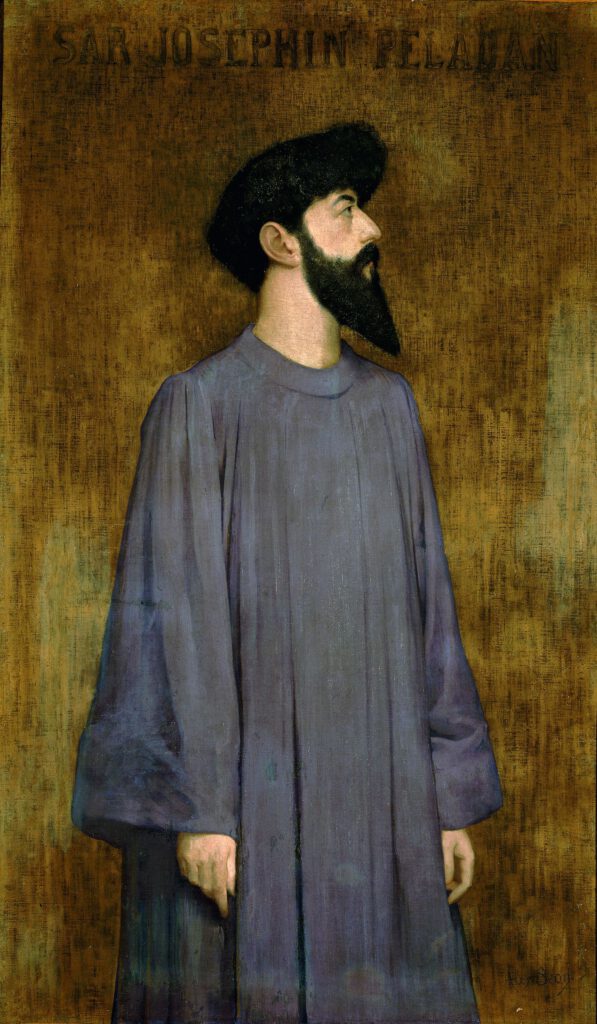
I am reading Sasha Chaitow’s ‘Son of Prometheus: the Life and Work of Joséphin Péladan’ (Theion Publishing, 2022) with great interest. It is the first modern and comprehensive study of Péladan and, above all, a study in which Péladan is not regarded as a charlatan but as a serious writer and (esoteric) philosopher. That esoteric aspect may not be to everyone’s taste – nor is it to mine, personally – but however you look at it, it is a highly relevant element in the history of art and culture. Readers of this site will, like me, probably be interested in Peladan primarily because of the Salons Rose + Croix that he organised annually from 1892 to 1897.
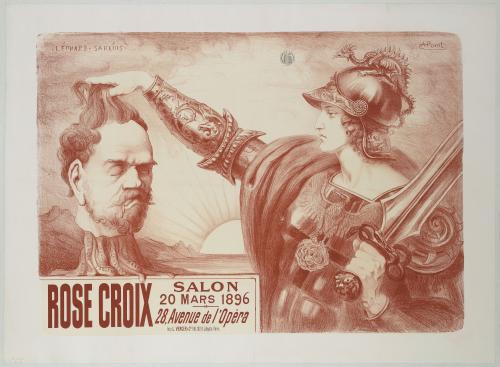
At these groundbreaking exhibitions in Paris, the leading Symbolist avant-garde artists of their time exhibited their work, including: Léonard Sarluis, Jan Toorop, Alexandre Séon, Jean Delville, Carlos Schwabe, Ferdinand Hodler, Fernand Khnopff, George de Feure etc.
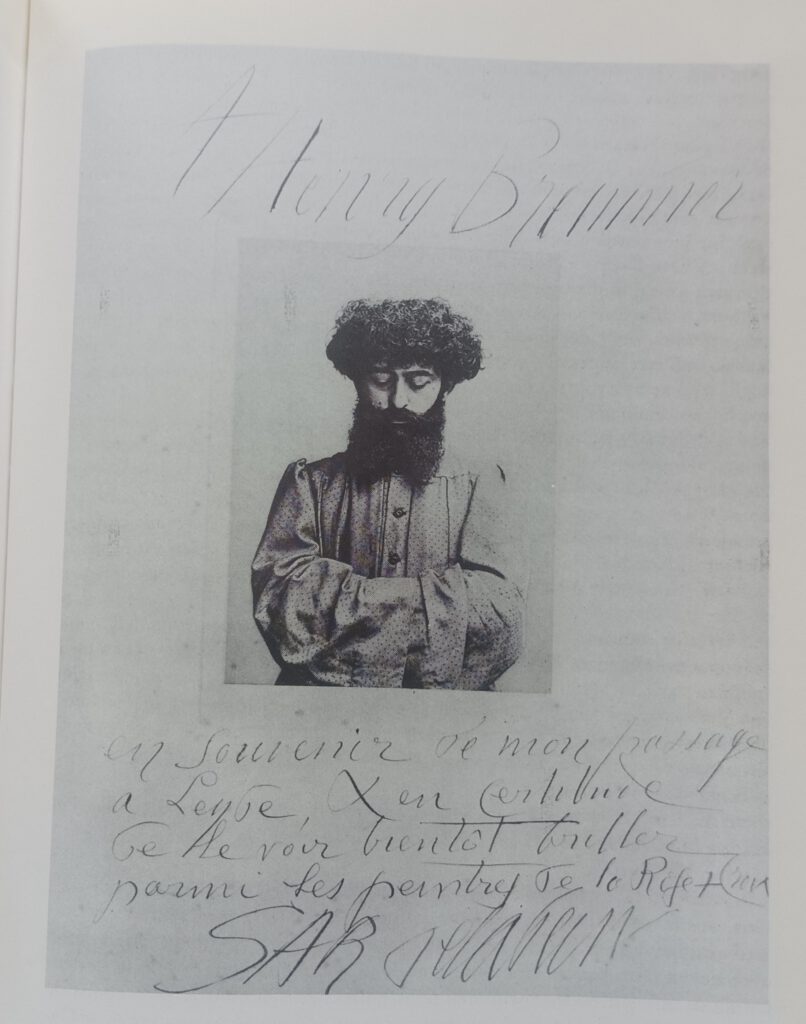
To promote his ideas on art and the Rose + Croix, Peladan travelled throughout Europe and also visited the Netherlands in November 1892. This is well known, although few outside the Netherlands are familiar with the details, probably because the only documentary source is the 1985 Dutch-language book by A. Vis & F. Heijbroek, ‘Verlaine in Nederland’, in which the authors also discuss Peladan’s visit on pages 119–126; he was in the Netherlands during the same months of November 1892 as Verlaine.
Their book is primarily a collection of highly interesting documentary sources and quotations. One book they quote from is ‘Nieuwe buitelingen’ (1955) by the popular Dutch writer Godfriend Bomans (1913–1971), which contains a chapter on Verlaine’s visit to the Netherlands. I have included here a translation of all Bomans paragraphs concerning Peladan. Bomans writes wittily so I quote him here. He cites several of the sources also used by Vis and Heiijbroek so these contemporary Dutch sources on Peladan are now available in English for the first time.
Lastly, Bomans must have had some interest in the Symbolists. His friend and illustrator Harry Prenen (1915–1992) was a great admirer of the work of the Dutch Symbolist Carel de Nerée (1880–1909). Prenen owned works by De Nerée and wrote several articles about the artist. Sometime in the 1930s, Prenen gave Bomans a nude drawing by De Nerée which he had bought from the Haarlem art dealer J.H. de Bois. I have not yet been able to ascertain exactly which drawing this was.
Be that as it may, here’s a healthy dose of relatively little-known Peladaniana for your reading pleasure!
‘(…) Meanwhile, a second French celebrity – albeit one of a less unsuspicious nature – was wandering through the Netherlands: Sár Péladan. This half-genius, half-mad eccentric, a discovery of Barbey d’Aurevilly, claimed to be a descendant of the Babylonian king Hérodack and, as such, adopted the title ‘Sar’. He wrote a nineteen-volume cycle of novels [= the 21 vols. Decadence Latine], founded a Parisian art salon – the ‘Salon de la Rose-Croix’ – revived the medieval Rosicrucian Order, and, as its Grand Master, appeared in a costume which [Johan] Thorn Prikker [symbolist artist, 1868-1932], having attended one of his lectures in Leiden, described to Henri Borel as follows: ‘…the Sár looked magnificent, wearing high, grey knee-high boots, a purple blouse with stripes down the back, and very finely pleated at the front. He wore a black tie with white lace. You are surely familiar with his portrait, with his long, black beard, his halo of black hair, and very pale complexion. Moreover, instead of a coat, he wore a monk’s habit with a large hood, which he had pulled over his head that evening. In short, at first glance he comes across as a poser. The Sár spoke at great length about art, and found, for example, the landscapes of modern painters appalling: ‘ce n’est que de peinture’; he wanted to see more of the soul of the landscape, not the portrait of the trees, and so on.
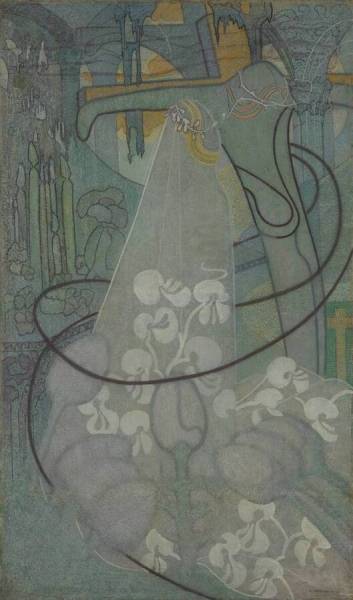
He spoke about the Salon Rose et Croix, explained something of the purpose of that exhibition in contrast to the usual salons in Paris, and gave a major lecture on ‘Women’.
He considered them abominable creatures, who were always far inferior to men, nothing more than an instrument to be played upon now and then. [Chatow argues that Péladans philosophy actually has feminist dimensions. I still have to read that chapter so more on that later]. Nothing great as a whole has ever been created by a woman. That is why they were scoundrels; he despised them with all his heart…” That marvellous coincidence, which, like frost on a windowpane, sometimes conjures up discoveries that a mere mortal could not conceive, now took pleasure in bringing Péladan and Verlaine together. According to Dr. Alberdingk Thijm [1864-1952. Wrote under pseudonym Lodewijk van Deyssel and was part of the Movement of Eighty, the literary and artistic avantgarde of the 1880s which also included painters like Jan Toorop, George Breitner, Jac. Van Looy and Johan Thorn Prikker] whom I asked about this, the event took place on a canal in Leiden [according to Vis & Heijbroek p. 125 the two did not meet in Leiden thought their arguments against this are not quite clear to me]. The Sár, being the first to spot Verlaine, stopped in his tracks and, taking a step backwards, bowed to the ground; he repeated this manoeuvre, moving backwards each time, on three occasions. Only then were the astonished residents of Leiden able to witness a handshake which, offered warmly by Péladan and accepted with reserve by Verlaine, was observed by all the bystanders with undisguised amusement. Péladan, whose authority, like that of any charlatan, was precarious, seized the opportunity to enlist Verlaine’s support and invited him to attend one of his lectures in The Hague.
Whether Verlaine did not wish to disavow a fellow countryman in the presence of others, or whether he was genuinely interested in the talk, he accepted, and fate now presents us once again with a remarkable spectacle: Verlaine at a reading by the Sar. It took place in a small hall at The Hague’s ‘Kunstkring’ [where by the way in may 1892 Jan Toorop had organised the first ever Vincent van Gogh exhibition], and according to Verlaine himself dealt with ‘La Magie et l’Arnour’ (‘if I am not too grossly mistaken’), according to Prikker with ‘The utter insignificance of women’, and according to the journalists present at the time, with absolutely nothing. If we may venture a guess ourselves, we are inclined to suppose that Verlaine had the title in mind, Prikker the gist, and the journalists the content; thus, the possibility that all those involved were correct cannot be categorically ruled out. Be that as it may, Péladan had ensured that, should the ear be somewhat at a loss, the eye could more than make up for it: the mise-en-scène was masterful. Here is Verlaine’s own description: “…The room where Péladan is to speak is that of the Kunstkring, quite large but dimly lit. At the far end stands a proper podium, entirely covered with a yellow cross. To the right and left, in church candlesticks, burn four candles, two of which are the size of Easter candles, and the other two that of altar candles. Péladan appears from a distance, dressed in a black suit with a frilled collar and cuffs — a bizarre sight, yet one of great distinction in its own right. His voice is fine, also unique in its own right: deep, though somewhat weak. He speaks of magic, love and angels. In short, he is the controversial, yet still talented, Péladan. He steps down from the podium after an hour to rest. The audience is undecided.”
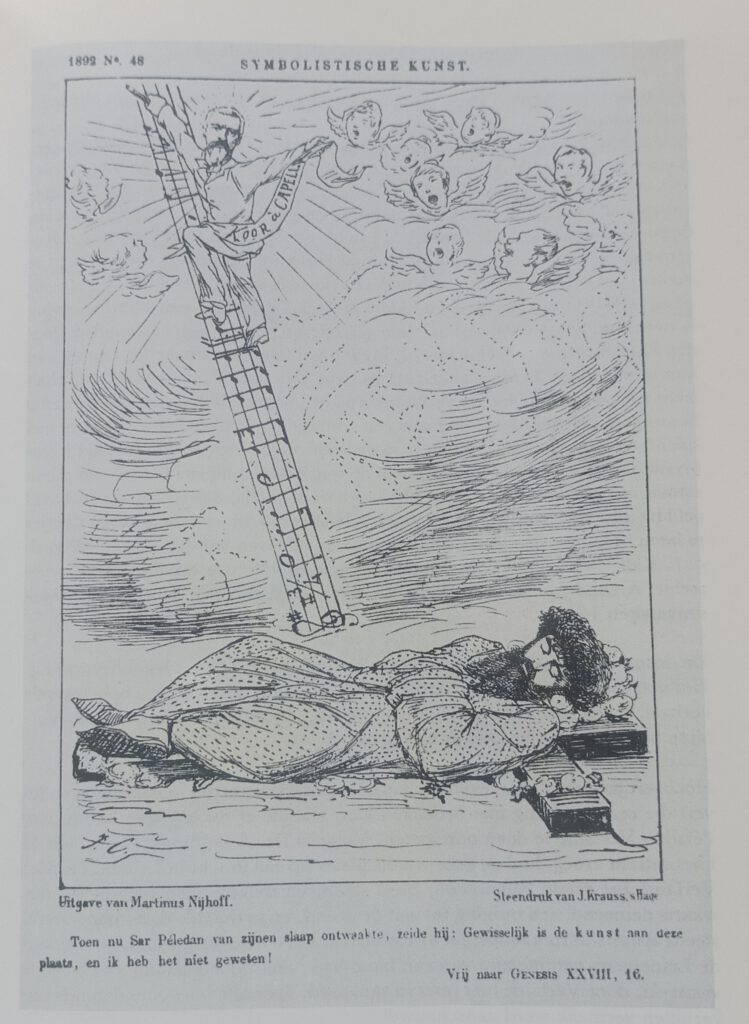
To round off his stay in the Netherlands, the people of The Hague – who were not about to let this opportunity slip by – treated Verlaine and the ‘Sár’ to a déjeuner together at the ‘Royal’ restaurant. Péladan, whose wardrobe seemed inexhaustible, turned up this time in an outfit that exceeded all expectations. He looked,” according to Prikker, “simply splendid: a black satin shirt with silver velvet trousers, high grey riding boots, a purple tie with white lace, an astrakhan cap, and a large black overcoat. Verlaine was wearing his felt hat, but not his red scarf. It must be said that the Sár was a pleasant conversationalist. Verlaine did not say as much as the Sár, but he was satirical. He said to me, word for word: ‘He has written a fine book (“Le Vice Suprême” [novel, 1884]), but there’s a flaw in him.’ And he was talking about the Sár, who, despite all his antipathy towards the woman, was nevertheless sitting quite comfortably next to her and chatting courteously with her. S. [unclear who this could be] then gave a nice little speech.
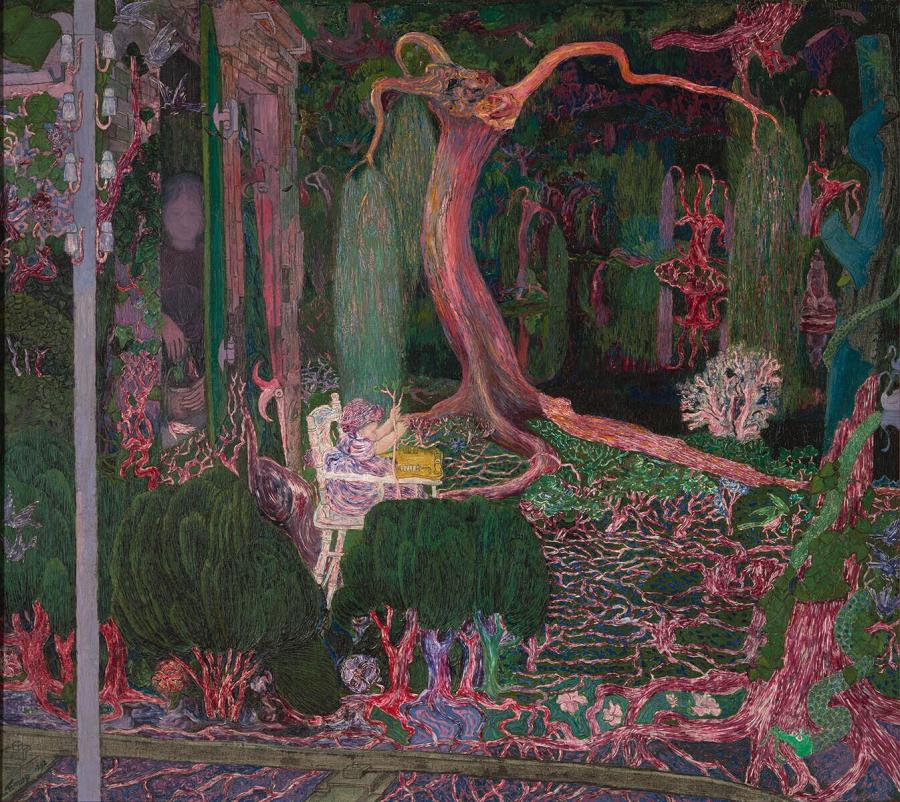
Jan Toorop ‘The New Generation’ Rotterdam, Museum Boijmans van Beuningen. Exhibited at the first Rose + Croix Salon, 1892 (cat. no. 176, p. 32)
He said to the Sar: ‘I am engaged and love my girlfriend very much; I believe she is a good woman. That is why, under the guidance of Monsieur Verlaine, who has written so many beautiful verses on love, I raise a toast to the ladies present here.’ The Sar, of course, joined in the toast, but said quite wittily: ‘To your folly, Monsieur S.’ Verlaine, who for two weeks had been accustomed to being the centre of attention, could not, however, stomach a certain resentment; and then, according to [Phillipe] Zilcken [artist and critic, 1857-1930], when during the interval someone’s hat was knocked off his head in his presence by an enthusiastic admirer, he slowly turned to those present and said in a moved voice: ‘Voilà. C’était en mon honneur…’ Finally, to convey the impression this visit made on the avant-garde of our artists at the time, I can think of no better way to conclude than by quoting the words the painter Johan Thorn Prikker wrote to Henri Borel [writer, 1869-1933] a full year later: “I am sending you a flower from Verlaine, the flower he wore in his buttonhole on the evening of the dinner at Riche. I swapped it with Verlaine that evening for one of my own, and I told him that I would give it to someone who was fully worthy of it…”